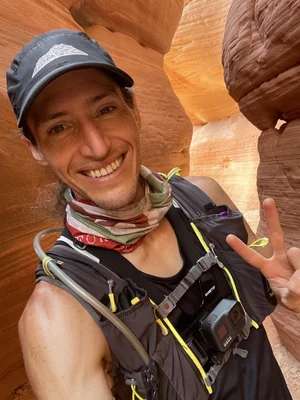
“A Small Light in a Vast Darkness” - Mo Khalil, West Bank, Palestine
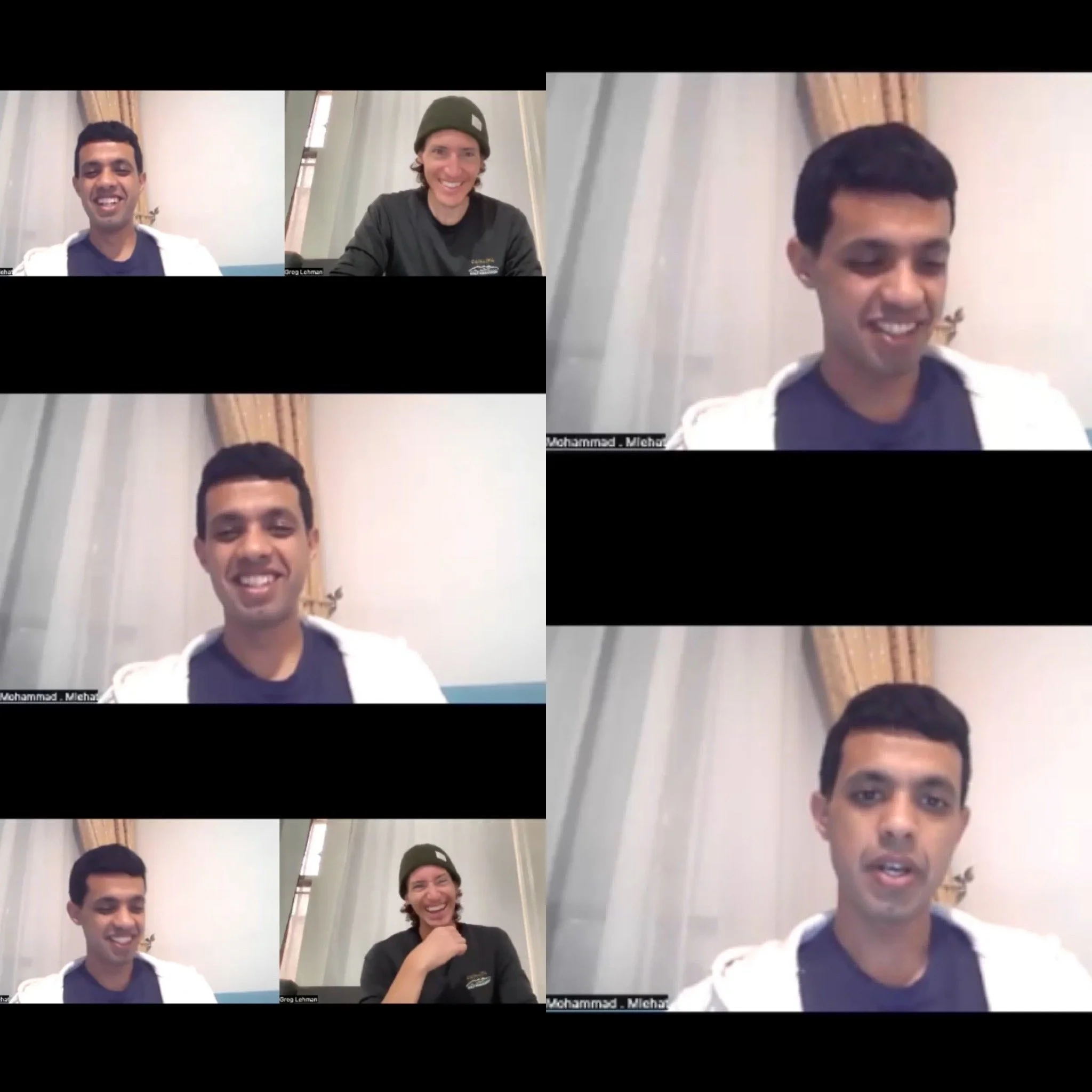
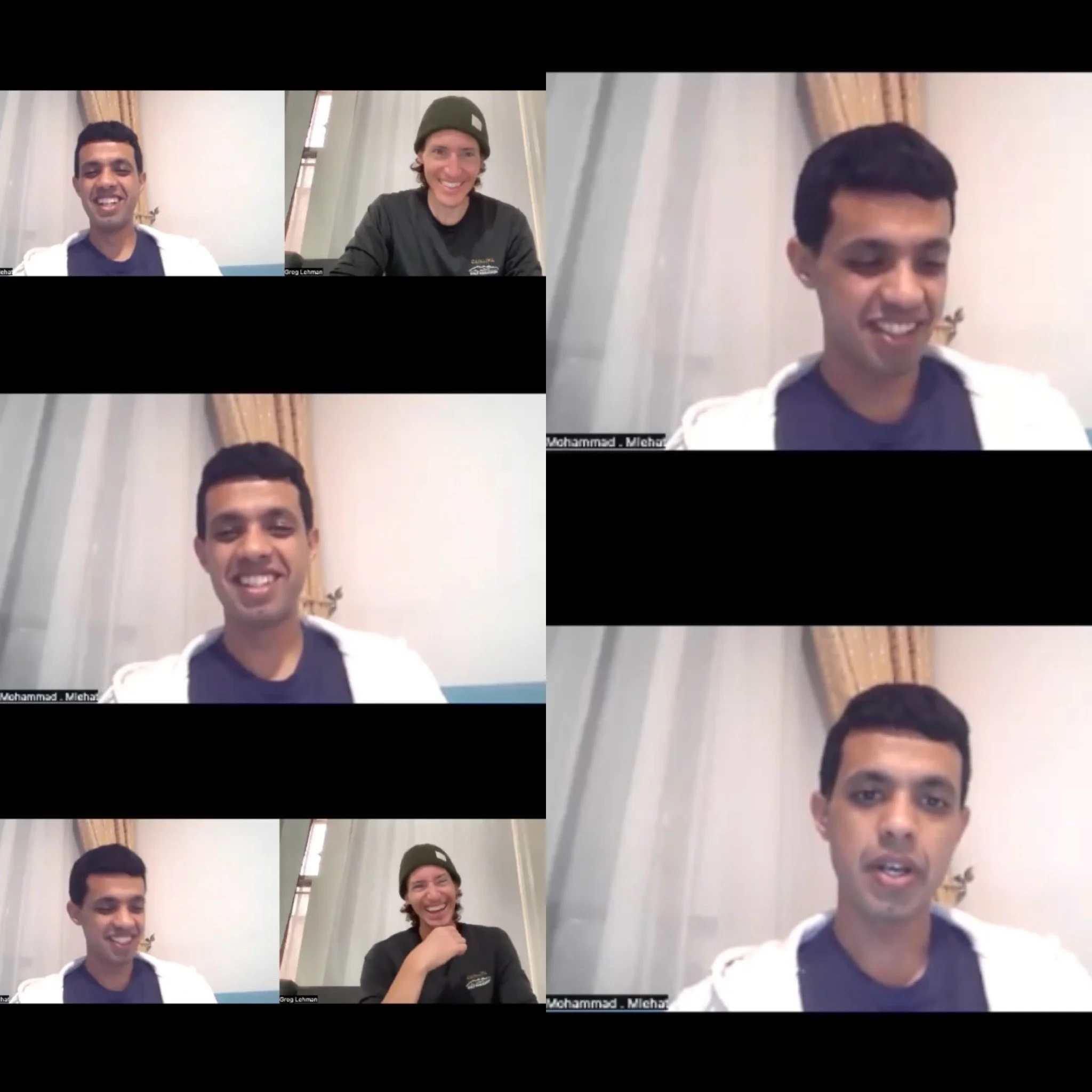
Mo Khalil was born in Hebron in the West Bank, Palestine, and at the current age of 28-years-old, with his focus on becoming the first Palestinian to bring an Olympic medal home in 2028, he told me about how the act of running had his heart from a very young age:
"My earliest memories of running go back to my school days, when I used to run around the yard without any plan, just out of excitement. I remember feeling an incredible sense of freedom."
Mo was and has been clear to me that his love for running extends to beyond performance and fitness, which we get into deeply in a profile I wrote about him well over a year ago
Mo's GoFundMe is very much live and is a practical source of support to help him personally in the near-term, as well as achieve his long-term goal of building resources for supporting young athletes in Hebron and Ramallah.
We recorded this video interview at the end of 2025, before which I had sent Mo questions to prepare for, and during which we used a translation app to add clarity.
Topics included the lack of progress in the so-called and empty promise of a "cease fire" has been like from Mo's perspective.
"It was deeply painful," Mo said, "even though I am far from the frontlines, the feelings of helplessness honestly never leaves me. During these days, running becomes my way to cope.... I run to release my anger and energy and to remind myself there is always hope in life, even in the darkest times."
Mo followed this up by summarizing one of the best messages I've come across anywhere:
"I would like my story to be shared as a message of hope, strength, and resilience for Palestine. Running has taught me that even when the road is difficult, every step forward matters. I want people around the world to know that, despite the challenge we face, we continue to dream, to run, and to believe in a better future. Through my story, I hope to inspire young people, especially in Palestine, to never give up on their goals, no matter where they come from or what would stand in their way. Every finish line begins with the hunger to start."
“A Small Light in a Vast Darkness”
Mohammad Khalil Militate loves to run.
The commitment that comes with this love is clear from the start of our conversations beginning in August 2024.
We’re linked virtually between Ramallah in the West Bank, where Mo lives, and Los Angeles, California, where I live, through a mutual connection in the running world.
After finding out about Mo, where he lives, and his goals of becoming a professional runner, I reached out to see how I could support him.
A warm and lively response was quick to come from Mo.
From the start, Mo has been generous and forthright in sharing what his life is like with me.
He tells me about his goals, which are among the highest one can reach for in the sport, set “on running and representing Palestine” in the 10k at the 2028 Olympics in Los Angeles, California.
As we first started to chat, his near-term goal of running in the Amman Half Marathon on October 7, 2024 was his primary objective, aimed at completing the 13.1 miles/21.1 kilometers in a time of 1:06 (requiring a pace at or just under 5:05 per mile/3:08 per kilometer).
His goals, significant and admirable, are remarkable in any time and place.
The variables Mo has and continues to contend with, as both a Palestinian and athlete, are among the hardest imaginable.
After agreeing to my writing about his journey, Mo shares details about the day-to-day challenges of living in the apartheid conditions that define his homeland.
The West Bank has been and is currently held in an intolerable status quo that has framed the entirety of Mo’s life and that of his family, who took up residence in an area south of Hebron after being displaced in 1948.
The subjugation of the Palestinian people has only scaled up since then, sustained by corruption in state craft on an international scale.
The situation has been dire and tragic long before the events of October 7th, 2023, which captured global awareness and action in ways unsurpassed until then.
Totals on how many Palestinians have been murdered, injured, and displaced in the ongoing genocide since then are difficult to estimate.
Given this current and developing crisis, any athletic pursuits at all would seem impossible.
Maintaining the practices that go into specialized training are difficult even in ideal conditions, requiring great discipline, personal passion, and access to the necessary nutrition, guidance, and gear that a body needs to boost performance.
The way Mo keeps to his training and focus, running is apparent as a source of strength and centering, a deep well from which he draws direction, solace, and ambition.
For him, the embodied effort that comes with running also serves as an outlet for the turmoil that comes with his life in Ramallah.
He summarizes as much early on in our conversation:
“I’m here inside a prison,” he tells me.
He tells me about the limits on safe spaces and times during which he can run, patrolled as most areas are by the military.
In the city he lives in, the streets run thin, sparing little room for vehicles, let alone runners.
Nearby agricultural roads would be prime spots to run on, with the West Banks’ highlands made up of prime terrain, views, and vertical profiles ideal for building fitness.
These are are off the table, however, since they “have a semi-permanent presence of settlers and occupation forces,” Mo said, as “the occupation authorities control all the highlands in the West Bank,” Mo said.
With pervasive checkpoints, the barrier wall, and constant surveillance at hand, Mo’s running and daily living situation is “a huge ordeal.”
Mo speaks to Israeli soldiers making “daily incursions by the occupation forces into the city,” he says, “which often coincide with my early morning training hours.”
The pressure throttles the volume and time he can put into his practice, as he tells me, “Many times, I only manage to run half a kilometer before returning home, due to the presence of occupation forces.”
The threat they present is simple.
“When they see anyone on the street,” said Mo, “they shoot at them.”
Amazingly, his resolve is immovable.
He beats traffic to use the roads available in the earliest hours possible, and he still needs to check to see if the routes are being patrolled by soldiers.
“You have to assess the conditions in the area when you wake up in the early morning,” Mo told me, “and then decide to train based on the surrounding conditions.”
Projecting for the future, as always, has its limits.
Mo shared an incident that saw him returning home from a training run to find “a large force of soldiers near my house, and I narrowly escaped.”
He does not go into further detail, and the language is terrifying.
Still, Mo frames our correspondence with pride for Palestine, on a calling to sport that could apply to anyone hoping to perform at world-class standards.
“The world of running is tough and vast, requiring great patience,” Mo tells me, “and I hope to leave a clear mark in the world of Palestinian running.”
In Mo’s words, “there is hope for the future, but it feels like a small light in a vast darkness.”
As we keep talking over the days and weeks, the metaphor gains heat, burns brighter and hotter as first-hand accounts, footage, and photos continue to stream out of the West Bank and Gaza, confirming and consistently one-upping what quality news sources report.
Mo’s messages cut deeper still.
On September 21st, 2024, the first message I get from him reads: “I’m not well at all,”
This is alarming to read, and sadly not surprising at all.
Arriving in the midst of yet another escalation of Israeli attacks on Gaza and the West Bank, the losses inflicted on the Palestinian people are severe.
After asking for him to tell me more, Mo says, “Today I had one meal, a little rice and a piece of bread, and now I can't sleep from hunger.”
Of all things, he tell sme shame adds to his pain.
“I’m sorry to explain my health condition to you,” he tells me, “but you're the only person I'm talking to at the moment.”
I tell him to not apologize. I tell him that the occupation is not his fault, how I am here for him, however possible, as I continue to work on connections with media, promoting his fundraiser site, and my writing about him.
Mo says explaining the situation is difficult, but he tells me plenty when he calls this time “the worst days of my life.”
Training for Amman, however, remains an anchor, a through-line to guide him forward.
But, says Mo, “sometimes I can’t run because I don’t have enough food, so I decide not to run out of fear of a physical collapse.”
As committed as he is, he is candid when he shares temptations to abandon his practice. Maintaining a routine, understandably, is at times out of reach due to the presence of troops and slim resources.
And the details are stark.
“I tried to survive on five dollars a day,” he tells me. “Sometimes even less, just to buy bread and basic necessities.”
To continue at all speaks to strength of the rarest type.
And, perhaps most shockingly, Mo tells me: “I’m not strong enough.”
He tell me how he is sorry, that he is ashamed.
I encourage him as best I can, and we keep messaging, his words shifting between embarrassment and resilience.
His pacing is frantic at times, consistent with fatigue atop a lack of nutrition to the point that “the hunger keeps me awake.”
Mo tells me monetary details, about moving forward with $300 a month for food and rent.
The numbers are upsetting, the ambition striking, both grappling as they are with goals kneecapped by conditions outside of Mo’s control.
“I want my tragedy to be a responsibility that no one can bear,” he tells me, emphasizing that, “I do not want to be a burden on anyone.”
Running.
Running, as a physical act, is defined by any pace that sees both feet leaving the ground at once, setting it apart from walking.
Running is, at base, to part with the hard laws of gravity, an act of physical freedom, a sequence of launching into one airborne stride to the next.
Running can be enjoyed alone or with others, practiced for reasons profound or at surface, play out as an outlet for any number of emotions, and be pursued by any number of combinations of self-growth and nourishment, service and fun, exploration of any terrain or area, and plant and enrich social connections near or far.
Running, though conditional on the privileges of working legs and sound health, builds one’s abilities to push and pull at challenges tangible and intangible, in ways few other acts can.
Running is a literal embodiment of will.
Running meets and nourishes self-worth, contends with doubt, builds friendships, and engages well with loneliness, trauma, and healing.
Running, like anything else in this world, is beholden to context, constraints, and the mystery of how some can exceed expectations in both.
Mo, as a runner, brings love and commitment to a sport that sees past the oppression of the history he has inherited.
As we talk, he exemplifies all of this in many, many ways.
The day after Mo messages me about not feeling well, I wake up to the following:
“Hello, my friend,” he begins, “thank God, I am extremely happy today. The amount of joy inside me is indescribable.”
This is very welcome to read, and Mo goes on to tell me he went out on a morning training run, a choice he was weary of, given where he was the day before, and the fact that he did not know if there would be any food for him when he came back.
“The training was very tough,” he said. “But my faith in God was strong, and at the fourteenth kilometer, I found a coin worth $15.”
Finding money, he told me, charged his pace to a sprint.
“People were looking at me, but I was so incredibly joyful,” he said. “I’ll be able to buy food for the next three days.
“Tomorrow, I’ll run in the morning. I’m so happy, and I just wanted to share this funny and encouraging moment with you. This coin will be part of my success story one day. God doesn’t forget anyone.”
I tell him I am very happy for him, and how I wish a dependable, routine source of income and nutrition was not a matter of chance and the generosity of others.
Mo tells me that to write about any of this is helpful, the questions welcome, that they “help me a lot in talking about reality in a realistic and strange way. I have never faced such questions before.”
In sharing “the reality of Palestinian runners,” Mo keeps me updated in real-time as the Amman Half Marathon approaches, made all the more real as he shares hard details about his financial situation.
With less than two weeks before his race, he messages me, “Now I only have 100 dollars, and I need $1,000 (to) travel, accommodation, and exit costs.
“I have a visa for Oman, but I hope to go out. There is not much time left.”
We keep in touch.
News out of the region gets worse.
Long bouts of silence concern me.
Then, on October 4th, 2024, the Amman Half Marathon saw Mo reach the starting line successfully.
The journey there, back, and depleted resources gave him a less-than-ideal race that fell short of his goal of 1:06.
After the race, he tells me, “I’m doing well and still have a lot of hope,” given what he calls "failure in this half marathon experience.
“Everything was difficult.”
Mo described hitting a wall of extreme fatigue with less than 4 miles/7 kilometers to the finish line.
The issue is common, but markedly so as Mo’s energy was tapped from the constrictions around diet and training that have cinched in around the deteriorating situation in the West Bank.
The process of getting to race day in Amman, the capital of Jordan, Mo tells me, was “like something out of a nightmare. We waited for 8 hours just to leave. When we returned, it was the same thing: crossing three checkpoints - Palestinian, Israeli, and Jordanian. These checkpoints are within a 10-kilometer distance, but you spend half a day just to cross.
“I’ve come to hate leaving Palestine because of the humiliation I experienced at the border,” Mo said.
"It felt like they were treating us like dogs, not humans.”
With all of this, however, Mo still centers his perspective on growth.
“I learned many lessons from this experience,” he tells me, his focus resilient as ever, consistent with what he told me before Amman that running in Ramallah in 2024 is to be clear-eyed about finding strength inside himself, since, “commitment to running day after day means that what comes next is the hardest part of training, because you cannot follow a long-term training plan due to economic conditions.
For his training, Mo cited social media as “the only way” he gleans guidance, which he tries to follow as much as possible, since according to him, “The sports system in Palestine is completely collapsed due to the occupation and colonial policies.”
Because of this, personalized coaching is not available.
“The official federation cannot provide a coach or attract expertise from abroad,” he tells me, “which is very unfortunate.”
Because of this, Mo said leaving his country and training outside of Palestine is his foremost priority, since, he said, “honestly, you cannot change the bad reality that does not provide a place for training. The occupation is present.”
A safe space to run at anytime, within a supportive community, is a given for many runners. To know the autonomy and joy denied to Mo by not having these things is to be inspired to help him, especially since the drive he holds is twofold.
Mo tells me that much of his running is compelled by a desire to inspire and give practical support to his fellow Palestinians, the latter a goal that would see a consistent supply of running gear, re-upped monthly, to support his community.
This would be a product stream that is non-existent as of now.
Currently, Mo shared that “you may get (running gear) when someone travels outside Palestine to buy it and then brings it back. This might happen once a year or more, and you may run in the same shirt for four years. There are no specialized stores for equipment.”
To fill this foundational gap in his local community, Mo said that if he was given the ability to do so, he would “build a specialized system for runners in Palestine in the future through (my) experience and creating as many sports facilities as possible.”
These resources would then be available to all runners in the area, which ranges from runners with Mo’s professional aspirations, to those seeking peace of mind and fitness in the activity.
Following similar trends in cities around the world, Mo shared that there is a local group of runners that meets up on a weekly basis for exercise, friendship, and “to relieve the pressures faced by Palestinians here.”
Mo’s own social circle in running is small, and he is quick to say good things about a local friend and training partner, who lends advice around ideal times and routes for training.
This friend is also a welcome presence when they run speed workouts together, Mo said, adding that, “having just one person to do speed sessions with is a treasure for me.”
The support is invaluable to staying with the sport.
Mo spoke to close friends that have abandoned running as the physical and psychological stresses and lack of resources run rampant under occupation.
He said he understands completely, since, “Runners here expect many difficulties, but are surprised by the impossibility of continuing training and improving their level.”
The cumulative effect of meeting goals and pushing thresholds in training demands key ingredients of recovery, nutrition, and guidance.
This process is full of nuance and variables that are different between every athlete’s journey, with all kinds of challenges and setbacks making for a journey that is never going to be straightforward or easy for a runner.
Taking this situation into a hostile environment like the West Bank, further endangered by war zone conditions as of late, makes for a place and time that hold Mo’s goals at greater and greater distances.
Discouragement is part and parcel of the process.
Mo said that even with the running he gets to do, “when you go out to train in the morning, you cannot feel any achievement at all, despite running a training session, because you continue to struggle with difficulties, excessive thinking, and high-(level) planning that lead to minimal results.”
He respects but bemoans his Palestinian friends who have quit the sport as “talents (that) have been lost,” stories cut short by the sustained closing of freedoms enjoyed by athletes all over the world.
Indeed, no priority tops Mo’s safety for me as I write this.
He is selective in telling me what he does and does not want shared publicly from our correspondence, as well as things he will not even share with me.
I would not work with any other option, especially as surveillance in his region and the threats that come with it are “an important and dangerous thing.”
For instance, Mo is active on social media, but will keep his training off the channels to stay safe.
The reasons for this secrecy are abundant, but hit close with a friend he tells me about from Bethlehem.
Mo tells me, “more than a year ago (this friend) was running next to the separation wall, because the wall cuts off from the camp where he lives.”
He shares that after Israeli forces observed this athlete, they deemed them as a threat, since other runners would see the intolerable conditions people must contend with under the occupation.
Because of this, according to Mo, the runner was arrested, “and he is now in prison. His ambition and dream have been lost.”
When asked about other runners who might be willing to share their experiences as well, Mo said that real dangers keep most from commenting.
One in particular told Mo that the chance of losing employment from going on record holds them back from sharing about their struggles.
“There’s a huge problem,” said Mo, “which is that it's not easy for someone to speak about freedoms here, as they would be persecuted.”
In one particular sentence that works well as a mantra, Mo said, “if you were outside of Palestine, you would have many places that encourage sports.”
Ultimately, it is Mo’s hope that “everyone understands the circumstances Palestinian runners face inside the Palestinian territories.”
His mission is to share as much information as possible while balancing is own safety in order “to convey the truth I’m living.”
Mo keeps me updated routinely, both on his training as well as the dangers he faces.
Very recently, his 14-year-old brother was seen running near the apartheid wall by occupation forces.
This, according to Mo, prompted Israeli forces to make a night-time raid on his family’s home, as well as threaten to arrest his brother if he trained near the wall again.
“The situation is distressing,” said Mo, “but we hold onto our dreams to keep running.”
In late October, Mo shared that he would restart efforts to leave home for a training camp outside the West Bank, with consistent updates on the way.
He also underlined his hopes that getting his story out would support his brother as well, who shares the same passion and talent for running as Mo.
“I have stumbled a lot, my friends,” Mo told me and a fellow collaborator in getting his story out, “but I have great hope that one day I will be what I want.”
In the process of writing and editing he gives troubling updates, one from November 9th reading:
“….regarding my personal situation everything is not okay I stopped training for ten days due to harassment and the occupation forces stormed my family's house a week ago so it was difficult to continue and I returned to training only two days ago but the interruption will not help me much so things are getting worse and the monitoring is tightening and I do not want to harm my family so do not be surprised that I have been silent a lot for the sake of my safety and the safety of my family….”
Mo then shares the following on an Instagram story:
“The occupation forces
are currently raiding
our home while I am
with my family in
Hebron. They are
conducting random
searches, banging on
doors in the middle of
the night. I was startled
from my sleep to find
soldiers by my bedside.
This is the fourth time
this month they've
come just to disturb the
sleeping children. Even
in sleep, there is no
sense of safety. Curse
the occupation.”
On January 21st, 2025, he sends me these updates following the “ceasefire,” an empty phrase as no change in violence or loss of lives continues:
“After Gaza, all troops go to West Bank….
“The situation is very bad now in the West Bank…. Closing everything, it seems that there will be genocide in the West Bank after Gaza because the city of Jenin is being bombed and everything is almost closed, the situation now onward will be worse.”